Clownfish or anemonefish are fishes from the subfamily Amphiprioninae in the family Pomacentridae. Twenty-eight species are recognized, one in the genus Premnas, while the remaining are in the genus Amphiprion. In the wild they all form symbiotic mutualisms with sea anemones. Depending on species, clownfish are overall yellow, orange, reddish or blackish, and many show white bars or patches. The largest can reach a length of 18 centimetres (7.1 in), while some barely can reach 10 centimetres (3.9 in).
Symbiosis and mutualism
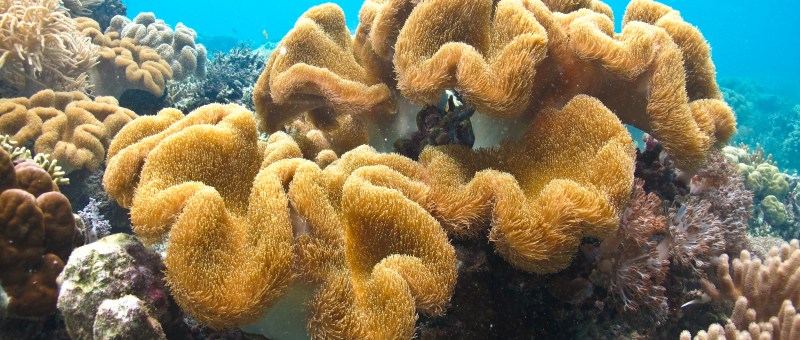
Clownfish and sea anemones have a symbiotic, mutualistic relationship, each providing a number of things to benefit the other. The individual species are generally highly host specific, and especially the genera Heteractis and Stichodactyla, and the species Entacmaea quadricolor are frequent clownfish partners. The sea anemone protects the clownfish from predators, as well as providing food through the scraps left from the anemone’s meals. In return, the clownfish defends the anemone from its predators, and cleans it from parasites. The anemone also potentially picks up nutrients from the Clownfish’s excrement, and functions as a safe nest site. It has been theorized that the clownfish use their bright colouring to lure small fish to the anemone, and that the activity of the clownfish results in greater water circulation around the sea anemone.
Clownfish and certain damselfish are the only species of fishes that can avoid the potent poison of a sea anemone. There are several theories about how they can survive the sea anemone poison:
- The mucus coating of the fish may be based on sugars rather than proteins. This would mean that anemones fail to recognize the fish as a potential food source and do not fire their nematocysts, or sting organelles.
- The coevolution of certain species of clownfish with specific anemone host species and may have acquired an immunity to the nematocysts and toxins of their host anemone. Experimentation has shown that Amphiprion percula may develop resistance to the toxin from Heteractis magnifica, but it is not totally protected, since it was shown experimentally to die when its skin, devoid of mucus, was exposed to the nematocysts of its host.
A pair of pink anemonefish (Amphiprion perideraion) in their anemone home. BehaviorIn a group of clownfish, there is a strict dominance hierarchy. The largest and most aggressive female is found at the top. Only two clownfish, a male and a female, in a group reproduce through external fertilization. Clownfish are sequential hermaphrodites, meaning that they develop into males first, and when they mature, they become females. If the female clownfish is removed from the group, such as by death, one of the largest and most dominant males will become a female. The remaining males will move up a rank in the hierarchy.
Behavior
In a group of clownfish, there is a strict dominance hierarchy. The largest and most aggressive female is found at the top. Only two clownfish, a male and a female, in a group reproduce through external fertilization. Clownfish are sequential hermaphrodites, meaning that they develop into males first, and when they mature, they become females. If the female clownfish is removed from the group, such as by death, one of the largest and most dominant males will become a female. The remaining males will move up a rank in the hierarchy.
Clownfish lay eggs on any flat surface close to their host anemones. In the wild, clownfish spawn around the time of the full moon. Depending on the species, clownfish can lay hundreds or thousands of eggs. The male parent guards the eggs until they hatch about 6 to 10 days later, typically 2 hours after dusk.[citation needed
Definition from wikipedia.org
Photos by divers.ph


 divers.ph